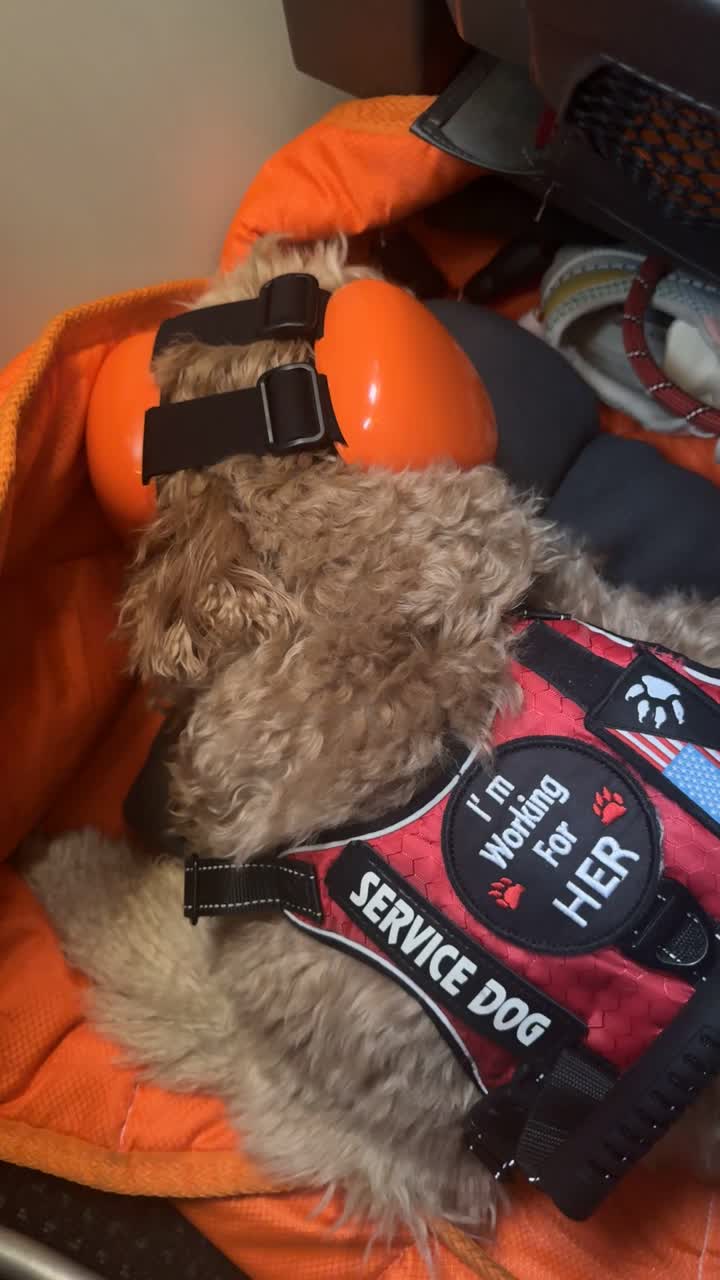
When the vest goes on, I am at work. Most people who make my job harder are being kind, and that is exactly why this school exists. The etiquette, the law, and the free card you can print.

Everything below is why that short list matters more than it looks.
Assistance Dogs International and the International Guide Dog Federation surveyed over 1,000 assistance dog handlers across 20 countries. These are their numbers, not ours.
Source: Paws for Access, a joint survey by Assistance Dogs International and the International Guide Dog Federation.
Individually trained to perform specific tasks for a person with a disability. Broad public access rights under the ADA in the United States. Peach is one of these.
Provides comfort by being present. No task training required and no general public access rights. Covered by different rules entirely.
Trained, and often certified, to visit other people in hospitals or schools by invitation. No individual public access rights.
All three are legitimate and none of them are the same thing. Blurring them is where that 65 percent comes from, and every handler pays for it at the door.
In the United States, this is what staff are permitted to ask. Most access refusals come from the newest person on shift, which makes this a training problem rather than a policy one.
There is no federal registry in the United States, so any certificate someone shows you means nothing in either direction. A service dog can be asked to leave only if it is out of control and the handler does not act, or if it is not housebroken.
This is a plain language summary for general education, not legal advice. Access rights and permitted questions differ outside the United States, and state and local law may add protections. See the ADA regulations for authoritative guidance.
One page. The etiquette, the three definitions, the two questions a business may ask, and what to say to a child. Made to be printed and put on a break room wall.
This is the shooting outline, published openly rather than shown as empty video tiles. The card above is finished and free today. Join the list and the episodes land in your inbox as they are cut.
When it goes on I am at work, and when it comes off I am a dog. The difference is visible if you know what to look for.
What actually happens to a working dog's focus when a stranger calls her, filmed from the dog's side of it.
Three legitimate things that are not the same thing, and why blurring them costs real handlers real access.
What a business may ask, what it may not, and how a refusal usually starts with someone who was never trained.
Why "you do not look disabled" is the sentence handlers hear most, and what a psychiatric service dog is actually trained to do.
"That dog is working" is enough. Children accept it faster than adults do, and taking no for an answer in front of them is the lesson.
A Goldendoodle dog actor and model based in Los Angeles, and a trained psychiatric service dog, not an emotional support animal. See her full work or book her.